RSI Expert-Michael G Tyshenko

Dr. Michael G. Tyshenko

PhD, MPA

Senior Health Risk Analyst

Joined RSI in 2018

  • Accomplished research scientist in molecular and cellular biology

  • McLaughlin Chair recipient, University of Ottawa (5-year endowed position)

  • Interdisciplinary training in Public Health and Administration (Queen's University, MPA)

  • International health policy teaching experience in China and Latin America

  • Over 100 peer review publications, 12 book chapters and 2 books

Dr. Michael G. Tyshenko is a Senior Health Risk Analyst at Risk Sciences International (RSI), where he has contributed since 2018 to some of the organization’s most complex and cross-cutting public health risk projects. As RSI’s lead on chemical peer reviews, he brings extensive experience in regulatory science, biological risk, and science-policy integration to high-stakes evaluations that require both deep expertise and clear communication.

Dr. Tyshenko’s research and collaborations span pandemic preparedness, emerging infectious diseases, and global risk policy, with applied work on SARS, MERS, and COVID-19. His current projects include policy analysis for the World Health Organization’s Global Technical Strategy for Malaria 2016–2030, identifying barriers to malaria reduction targets in Sub-Saharan African countries; ongoing collaboration with Nepal’s Ministry of Health on mobile and e-health approaches for remote populations; and ecological climate modeling with partners in Egypt and Saudi Arabia to project how climate change may alter pest distributions affecting biodiversity and crop productivity—providing insights for adaptive management and agricultural resilience.

Drawing on more than two decades of experience at the intersection of risk science, epidemiology, and public health policy, Dr. Tyshenko is recognized for advancing interdisciplinary approaches to health risk evaluation and for bridging scientific evidence with actionable policy.

Pre-RSI

Dr. Tyshenko’s career has consistently bridged the life sciences, public health, and public administration. He holds a Ph.D. and M.Sc. in Biology from Queen’s University, completed postdoctoral training in Public Health at the University of Ottawa, and earned a second master’s degree—a Master of Public Administration—also from Queen’s. This rare combination of scientific and governance-focused training underpins his distinctive contributions to health risk analysis and policy engagement.

From 2009 to 2013, Dr. Tyshenko held the McLaughlin Chair in Biological Risk Assessment at the University of Ottawa, where he led both academic research and applied science-policy translation. During this time, he developed and delivered Johns Hopkins–style short courses in public health across China through a five-year collaborative university–government initiative, and completed a parallel two-year project in Costa Rica, partnering with local and national authorities to identify public health policy gaps and capacity needs.

His leadership extended to the digital realm as Scientific Director of Risk.com, a knowledge portal providing curated summaries of global health hazards. Over the course of his career, Dr. Tyshenko has authored more than 100 peer-reviewed articles, 12 book chapters, and two books—cementing his reputation as a versatile thinker capable of bridging scientific disciplines and policy environments.
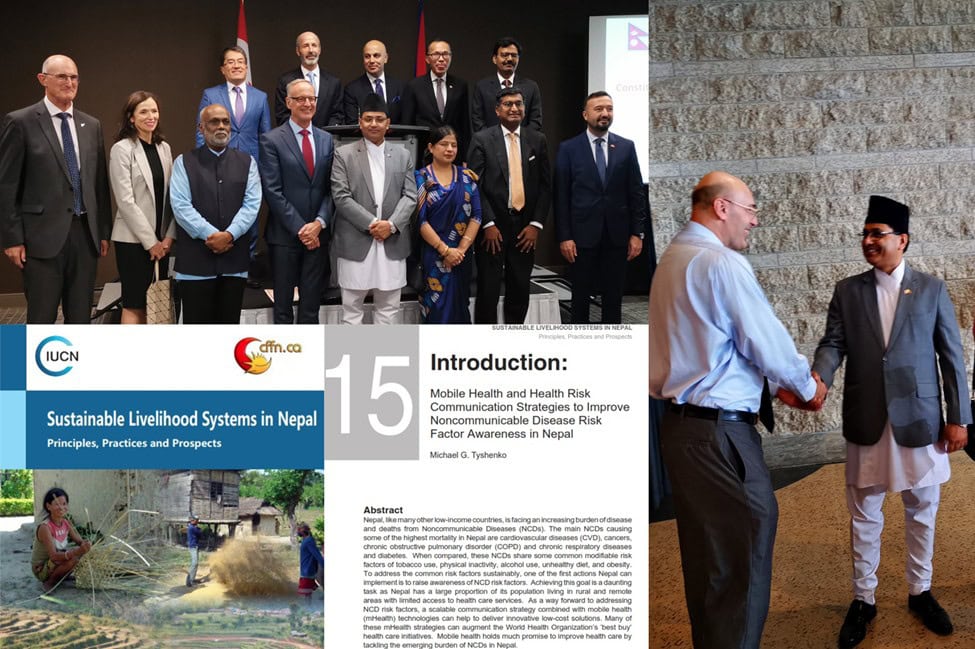
Celebrating Nepal’s Constitution Day with Mr. Bhrigu Dhungana, Nepal’s ambassador to Canada. Our work on sustainability in Nepal resulted in the IUCN sponsored book, Sustainable Livelihood Systems in Nepal where I acted and the English copy editor and contributor. A second project involved needs assessments for expanding mountain tourism in Nepal. (Sept. 19, 2022).

Case studies associated with Michael G. Tyshenko

EFSA Framework for Problem Formulation

PROJECT DESCRIPTION

To enhance the methodological rigour of its scientific assessments, EFSA sought to develop a standardised framework for problem formulation (PF) within its non-application scientific assessment protocols. The goal was to support the planning phase of these assessments by establishing a...
Read More about EFSA Framework for Problem Formulation

Expansion of the Stochastic Health Canada Quantitative Microbial Risk Assessment Tool

PROJECT DESCRIPTION

Health Canada sought to enhance its Quantitative Microbial Risk Assessment (QMRA) tool, originally developed over 15 years ago for stakeholders responsible for drinking water systems. With advancements in probabilistic modeling and microbial risk assessment, the client required updates to reflect...
Read More about Expansion of the Stochastic Health Canada Quantitative Microbial Risk Assessment Tool

Measuring impact of zoonotic animal diseases in Canada

PROJECT DESCRIPTION

The Canadian Food Inspection Agency sought RSI’s support in exploring how human health impacts from zoonotic diseases could be compared consistently with other public health risks. Traditionally, animal disease control decisions relied on veterinary and economic measures, but there was...
Read More about Measuring impact of zoonotic animal diseases in Canada

Finalization of Risk Assessment on Secure Opioid Dispensing Devices

PROJECT DESCRIPTION

To support decision-making around modifications to opioid agonist treatment delivery, a detailed risk assessment was requested to evaluate the integration of secure dispensing devices for direct patient access to hydromorphone. Building on a previously conducted preliminary assessment, the work required...
Read More about Finalization of Risk Assessment on Secure Opioid Dispensing Devices

External Peer Review of the Draft Screening Assessment Report on Selected C3-C5 Alcohols

PROJECT DESCRIPTION

To support the quality and defensibility of regulatory decision-making under the Canadian Environmental Protection Act, 1999 (CEPA), Health Canada engaged Risk Sciences International to coordinate an independent external peer review of the Draft Screening Assessment Report (DSAR) for Selected C3-C5...
Read More about External Peer Review of the Draft Screening Assessment Report on Selected C3-C5 Alcohols

External Peer Consultation of the Inorganic – Late Biomonitoring Approach Draft Screening Assessment Report

PROJECT DESCRIPTION

To support the Chemicals Management Plan under the Canadian Environmental Protection Act (CEPA), Health Canada sought expert peer consultation for a draft screening assessment report (DSAR) evaluating 47 inorganic substances identified as priorities. The client required independent scientific and technical...
Read More about External Peer Consultation of the Inorganic – Late Biomonitoring Approach Draft Screening Assessment Report

Publications associated with Michael G. Tyshenko

Management of natural and bioterrorism induced pandemics.


ABSTRACT

A recent approach for bioterrorism risk management calls for stricter regulations over biotechnology as a way to control subversion of technology that may be used to create a man-made pandemic. This approach is largely unworkable given the increasing pervasiveness of...
Publication details about Management of natural and bioterrorism induced pandemics.

Characterization of antifreeze protein gene expression in summer spruce budworm larvae.


ABSTRACT

Not surprisingly, in the spruce budworm, Choristoneura fumiferana, antifreeze protein (AFP) gene expression is most abundant in the second instar, overwintering stage. However, low level RNA and protein expression was also found in the sixth instar larvae, a summer stage....
Publication details about Characterization of antifreeze protein gene expression in summer spruce budworm larvae.

Analysis of antifreeze proteins within spruce budworm sister species.


ABSTRACT

Spruce budworm (Choristoneura) species survive sub-zero winter temperatures by producing antifreeze proteins (AFPs) encoded by a multigene family of short and long isoforms. We report in this study the first analysis of antifreeze proteins from related Choristoneura sister species. The...
Publication details about Analysis of antifreeze proteins within spruce budworm sister species.

Hyperactive spruce budworm antifreeze protein expression in transgenic Drosophila does not confer cold shock tolerance.


ABSTRACT

Drosophila melanogaster, a freeze intolerant and cold shock sensitive insect, was transformed with the hyperactive insect antifreeze protein gene (AFP) from the spruce budworm, Choristoneura fumiferana. Transformation P-element constructs (pCasper) were made with CfAFP 337 isoform DNA using a strong...
Publication details about Hyperactive spruce budworm antifreeze protein expression in transgenic Drosophila does not confer cold shock tolerance.

A psychosocial risk assessment and management framework to enhance response to CBRN terrorism threats and attacks.


ABSTRACT

Evidence in the disaster mental health literature indicates that psychosocial consequences of terrorism are a critical component of chemical, biological, radiological, and nuclear (CBRN) events, both at the clinical level and the normal behavioral and emotional levels. Planning for such...
Publication details about A psychosocial risk assessment and management framework to enhance response to CBRN terrorism threats and attacks.

A single point mutation in Drosophila dihydrofolate reductase confers methotrexate resistance to a transgenic CHO cell line.


ABSTRACT

Sequence analysis of a cDNA encoding dihydrofolate reductase (DHFR) from a selected methotrexate-resistant Drosophila melanogaster cell line (S3MTX) revealed a substitution of Gln for Leu at position 30. Although the S3MTX cells were approximately 1000 fold more resistant to methotrexate...
Publication details about A single point mutation in Drosophila dihydrofolate reductase confers methotrexate resistance to a transgenic CHO cell line.

Cloning and characterization of a member of the Hsp70 gene family from Locusta migratoria, a highly thermotolerant insect.


ABSTRACT

A complementary deoxyribonucleic acid (cDNA) and the corresponding gene segment encoding a member of the 70-kDa heat shock protein (Hsp70) family have been cloned and sequenced from Locusta migratoria, the African migratory locust. These animals are noted for their thermotolerance,...
Publication details about Cloning and characterization of a member of the Hsp70 gene family from Locusta migratoria, a highly thermotolerant insect.

A family of expressed antifreeze protein genes from the moth, Choristoneura fumiferana.


ABSTRACT

The freeze-intolerant insect, Choristoneura fumiferana (spruce budworm), produces multiple antifreeze protein (AFP) isoforms for protection during the overwintering stage. We now report the cloning of AFP genes from insects; Afp-Lu1 encodes a approximately 9-kDa AFP isoform, and Afp-Iu1 encodes a...
Publication details about A family of expressed antifreeze protein genes from the moth, Choristoneura fumiferana.

Tobacco budworm dihydrofolate reductase is a promising target for insecticide discovery.


ABSTRACT

Structural differences in dihydrofolate reductases from different species have been exploited to develop specific inhibitory molecules, such as chemotherapeutic agents, antibiotics or antihelminthics, that show species specificity or selectivity. As dihydrofolate reductase (DHFR) is a crucial enzyme for the synthesis...
Publication details about Tobacco budworm dihydrofolate reductase is a promising target for insecticide discovery.

Search all publications

Expert editorials associated with Michael G. Tyshenko

Machine Learning and Risk Assessments – Are Humans Obsolete?

Human health risk assessment is a well-established methodology that identifies and quantifies the potential risk of adverse health effects in humans who may be exposed to chemical contaminants in environmental media, such as air, water, soil, and food (Fryer et al., 2006).  Human health risk assessments can extend to other areas...
Read editorial about Machine Learning and Risk Assessments – Are Humans Obsolete?

Outside RSI

Beyond his professional life, Dr. Tyshenko is a dedicated and accomplished triathlete, with over 100 Olympic-distance triathlons, multiple Half-Ironman races, and three Ironman completions to his name. He has represented Canada as an age-group athlete at the World Triathlon Championships in Deerhurst, later transitioning to longer endurance formats that echo the persistence and discipline he brings to his scientific work.

Dr. Tyshenko’s approach to public health is fundamentally holistic—integrating molecular biology, risk communication, ethics, and evidence-based policymaking. His athletic discipline, global perspective, and interdisciplinary fluency make him a valued contributor to RSI’s mission to understand, manage, and communicate health risks in a rapidly changing world.


Direct contact with Michael G. Tyshenko

Contact Form to Staff

Admin view only

Your name
Your name
First Name
Last Name