A Risk Sciences International Case Study

Building an international alliance and campaign
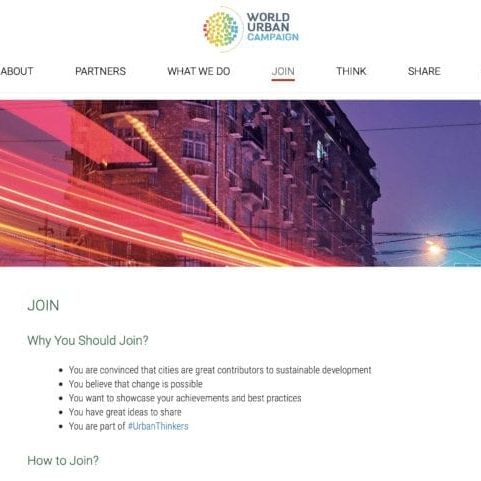
World Urban Campaign webpage screengrab

Client: UN-Habitat, Nairobi, Kenya

Listing of the client in no way affirms the client's support, sponsorship, or validation in any form of Risk Sciences International or the RSI staff member(s) who conducted this project during their stay with RSI or prior to joining the company. This case study is displayed for informative purposes only to demonstrate the capacity of RSI staff members. This case study reveals no proprietary information or information deemed sensitive.

Project description:

Building an international alliance and campaign

UN-Habitat sought to establish a new global platform to bring coherence to international dialogue on sustainable urbanization. At the outset, this initiative had no name, no identity, and no governing structure, only the recognition that cities faced pressing challenges requiring collaboration across governments, multilateral agencies, civil society, and the private sector. The client asked for a process that could convene high-level stakeholders, generate consensus on mandate and direction, and build a credible organization from the ground up.

Their request extended beyond conceptual strategy to the practical building blocks of legitimacy: assessment of the risks and operational implications of creating such a bridging organization; facilitation of stakeholder dialogue across diverse institutions, from United Cities and Local Governments to the World Bank and WHO; and design of the campaign’s identity, including its name, logo, mission statement, and governance structure. UN-Habitat also wanted mechanisms such as a steering committee and board in place to ensure credibility with member states and partner organizations.

The culmination of this work was the launch of the World Urban Campaign at the World Urban Forum 5 in Rio de Janeiro in 2010. UN-Habitat’s ultimate aim was not simply a launch event but the establishment of a lasting, multi-stakeholder platform that could drive dialogue, influence policy, and help achieve global commitments, particularly Sustainable Development Goal 11 on sustainable cities and communities.

Start: 2009

End: 2011

Experts related to this case study

Cemil ‘Jim’ Alyanak

Vice-President Communications and Strategic Initiatives

Cemil ‘Jim’ Alyanak joined Risk Sciences International (RSI) in 2018 and serves as Vice-President, Communications and Strategic Initiatives. In this senior leadership role, he leads RSI’s risk communications practice, drives cross-cutting initiatives, advances strategic in-house projects, and expands the company’s...
Read More about Cemil ‘Jim’ Alyanak

More RSI Case Studies

RSI presents a very small selection of case studies to highlight some of its key work.

International newspaper rethink

The International Herald Tribune (IHT) sought guidance at a time of profound change in the media landscape. With the World Wide Web emerging and competition intensifying from global and regional editions of established outlets such as The Economist, The Wall...
Read More about International newspaper rethink

Risk-Based Decision-Making (RBDM) Support for Plasma Supply / Sufficiency

Facing renewed challenges in securing a reliable domestic plasma supply, Canadian Blood Services sought support to apply a Risk-Based Decision-Making (RBDM) framework. The objective was to assess the value and implications of expanding domestic plasma collection and processing capacity in...
Read More about Risk-Based Decision-Making (RBDM) Support for Plasma Supply / Sufficiency

Contraceptive recall review

Health Canada requested an external review following significant public criticism of its handling of a pharmaceutical recall. The case involved a contraceptive drug that was withdrawn due to packaging errors, and the department faced questions about whether it had acted...
Read More about Contraceptive recall review

Risk Communication on McIntyre Powder

In response to increasing public concern about the historical use of McIntyre Powder—an aluminum-based substance once administered to miners in Ontario to prevent silicosis—the client sought expert guidance on managing risk communication related to potential health implications. Widespread media coverage...
Read More about Risk Communication on McIntyre Powder

Expansion of the Stochastic Health Canada Quantitative Microbial Risk Assessment Tool

Health Canada sought to enhance its Quantitative Microbial Risk Assessment (QMRA) tool, originally developed over 15 years ago for stakeholders responsible for drinking water systems. With advancements in probabilistic modeling and microbial risk assessment, the client required updates to reflect...
Read More about Expansion of the Stochastic Health Canada Quantitative Microbial Risk Assessment Tool

Evaluation of Toxicological Data on Experior

To support the evaluation of a new veterinary pharmaceutical product intended for use in bovines, a scientific review was requested of submitted toxicological data related to the active compound LY488756. This compound, proposed under the product name Experior, had been...
Read More about Evaluation of Toxicological Data on Experior