A Risk Sciences International Case Study

Risk-based decision making framework
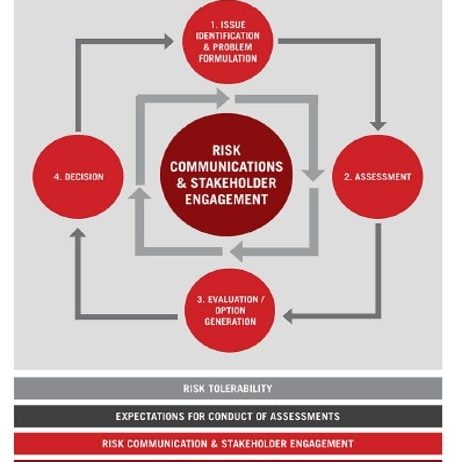
Risk Based Decision Making diagram

Client: Alliance of Blood Operators

Listing of the client in no way affirms the client's support, sponsorship, or validation in any form of Risk Sciences International or the RSI staff member(s) who conducted this project during their stay with RSI or prior to joining the company. This case study is displayed for informative purposes only to demonstrate the capacity of RSI staff members. This case study reveals no proprietary information or information deemed sensitive.

Project description:

Risk-based decision making framework

The Alliance of Blood Operators (ABO) sought to move its members toward a consistent, transparent approach to risk-based decision-making. Having worked through the development of a framework, the organization now wanted formal adoption, external validation, and practical application to real-world decision contexts. ABO’s request was twofold: to embed the framework as a standing resource available to all members, and to strengthen its credibility through peer-reviewed publication and international visibility.

Member organizations also asked for practical demonstrations of the framework in action. Canadian Blood Services, for example, requested support in applying the approach to the development of its national plasma collection strategy. At the same time, ABO sought further elaboration of specialized components of the framework, most notably the risk tolerability process. This included the creation of additional tools and guidance that would enable decision-makers to evaluate ethical and risk trade-offs in a structured, defensible way.

The overarching purpose was to provide blood operators worldwide with a systematic decision process that could handle scientific, ethical, and stakeholder considerations in a transparent manner. By adopting and applying the risk-based framework, ABO aimed to improve consistency across organizations, enhance defensibility of major policy choices, and strengthen public trust in the blood system.

Start: 2016

End: 2017

Experts related to this case study

Emma Hartnett

Vice-President Risk Modelling and Simulation

Dr. Emma Hartnett is Vice-President, Risk Modelling and Simulation at Risk Sciences International (RSI), where she has been a foundational member since its inception in 2006. A globally recognized authority in quantitative risk assessment (QRA), she specializes in developing risk...
Read More about Emma Hartnett

Anne Wiles

Senior Analyst

Dr. Anne Wiles joined Risk Sciences International (RSI) in 2008, where she currently serves as a Senior Analyst specializing in risk communication, perception, and governance. With a distinctive blend of expertise in language, regulation, and the use of science in...
Read More about Anne Wiles

More RSI Case Studies

RSI presents a very small selection of case studies to highlight some of its key work.

Airport traffic flow and signage review

An international airport authority sought a comprehensive assessment of passenger and vehicle traffic flow after receiving complaints of confusion and safety concerns. Reports indicated that passengers were struggling to interpret signage, often stopping too long to process graphics, which caused...
Read More about Airport traffic flow and signage review

Developing a Risk-Based Compliance Framework for Digital Service Delivery

The Financial Consumer Agency of Canada (FCAC) engaged Risk Sciences International to provide strategic advisory services aimed at enhancing its regulatory compliance model through risk-based methodologies. FCAC’s objective was to explore new approaches that would integrate digital tools and data-driven...
Read More about Developing a Risk-Based Compliance Framework for Digital Service Delivery

International newspaper rethink

The International Herald Tribune (IHT) sought guidance at a time of profound change in the media landscape. With the World Wide Web emerging and competition intensifying from global and regional editions of established outlets such as The Economist, The Wall...
Read More about International newspaper rethink

Risk-Based Decision Making (RBDM) Compliance and Enforcement

Innovation, Science and Economic Development Canada (ISED), through its Spectrum Management Innovation Directorate, sought support in applying risk-based decision making (RBDM) across its compliance and enforcement responsibilities. The department was looking for a structured and data-driven approach to prioritize regulatory...
Read More about Risk-Based Decision Making (RBDM) Compliance and Enforcement

Marine Planning and Conservation National Ecological Risk Guidance: Risk Communication Expertise

To support the refinement and implementation of its ecological risk guidance, a federal department responsible for marine conservation engaged expert assistance in risk communication. The primary objective was to ensure that the national guidance for ecological risk assessment—developed as part...
Read More about Marine Planning and Conservation National Ecological Risk Guidance: Risk Communication Expertise

Technical Support for Risk-Based Decision Making (RBDM)

To enhance the oversight of cannabis production under its regulatory mandate, the Cannabis Directorate sought expert support in developing a risk-based decision-making framework tailored to its compliance and enforcement responsibilities. The directorate aimed to better assess and respond to non-conformance...
Read More about Technical Support for Risk-Based Decision Making (RBDM)