A Risk Sciences International Case Study

International newspaper rethink

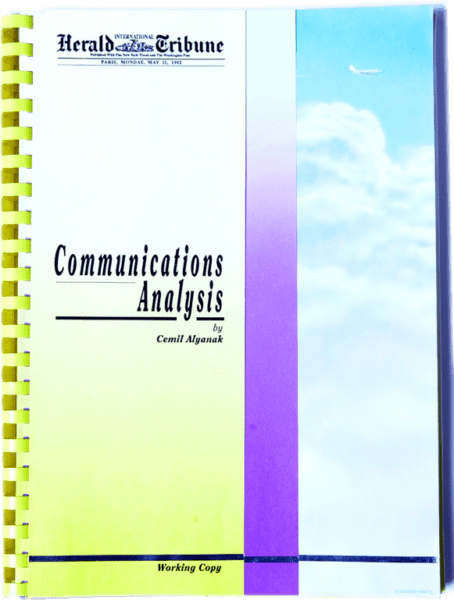
RSI's Cemil Alyanak undertook a complete analysis of the International Herald Tribune

Client: The New York Times, New York, NY, U.S.A. / The Washington Post, Washington D.C., U.S.A.

Listing of the client in no way affirms the client's support, sponsorship, or validation in any form of Risk Sciences International or the RSI staff member(s) who conducted this project during their stay with RSI or prior to joining the company. This case study is displayed for informative purposes only to demonstrate the capacity of RSI staff members. This case study reveals no proprietary information or information deemed sensitive.

Project description:

International newspaper rethink

The International Herald Tribune (IHT) sought guidance at a time of profound change in the media landscape. With the World Wide Web emerging and competition intensifying from global and regional editions of established outlets such as The Economist, The Wall Street Journal, and The Financial Times, the publisher asked for a comprehensive analysis to help chart a new direction for the paper. The request went beyond commercial concerns: leadership wanted to explore how the IHT could evolve from a respected newspaper into a global instrument for evidence-based communication, positioning itself as a trusted, unbiased source of factual information.

The client asked for a wide-ranging assessment that included: a competitive analysis of international media rivals, a study of the emerging role of the internet, an internal review of the IHT’s resources and ownership structure, and—most importantly—a perception analysis of current and potential readers. This combined intelligence was expected to inform options for strengthening the paper’s positioning and shaping its future role in the global media environment.

The overarching aim was to identify a strategy that would safeguard the IHT’s influence, adapt it to new technologies, and reinforce its reputation for credibility and authority at a critical juncture in international journalism.

Start: 1994

End: 1996

Experts related to this case study

Cemil ‘Jim’ Alyanak

Vice-President Communications and Strategic Initiatives

Cemil ‘Jim’ Alyanak joined Risk Sciences International (RSI) in 2018 and serves as Vice-President, Communications and Strategic Initiatives. In this senior leadership role, he leads RSI’s risk communications practice, drives cross-cutting initiatives, advances strategic in-house projects, and expands the company’s...
Read More about Cemil ‘Jim’ Alyanak

More RSI Case Studies

RSI presents a very small selection of case studies to highlight some of its key work.
Drinking Water Guidelines for Manganese

Establishing science-based drinking water guidelines for manganese requires integrating diverse regulatory approaches, emerging modeling tools, and evolving toxicological evidence. The client commissioned this project to systematically assess existing manganese drinking water guidelines and the scientific foundations upon which they are...
Read More about Drinking Water Guidelines for Manganese

Food safety risk analysis tools

The World Health Organization and the Food and Agriculture Organization of the United Nations asked RSI to develop a suite of online tools to support food regulators and the food industry in applying risk-based approaches to food safety. These organizations...
Read More about Food safety risk analysis tools

Wildfire and residential smoke risk communication

Government authorities faced recurring challenges in communicating health risks from smoke caused by both wildfires and residential burning. While these events were becoming more frequent and more severe, the public health messages often failed to resonate with affected communities or...
Read More about Wildfire and residential smoke risk communication

External Peer Consultation of the Inorganic – Late Biomonitoring Approach Draft Screening Assessment Report

To support the Chemicals Management Plan under the Canadian Environmental Protection Act (CEPA), Health Canada sought expert peer consultation for a draft screening assessment report (DSAR) evaluating 47 inorganic substances identified as priorities. The client required independent scientific and technical...
Read More about External Peer Consultation of the Inorganic – Late Biomonitoring Approach Draft Screening Assessment Report

Finalization of Risk Assessment on Secure Opioid Dispensing Devices

To support decision-making around modifications to opioid agonist treatment delivery, a detailed risk assessment was requested to evaluate the integration of secure dispensing devices for direct patient access to hydromorphone. Building on a previously conducted preliminary assessment, the work required...
Read More about Finalization of Risk Assessment on Secure Opioid Dispensing Devices

Developing a Risk-Based Compliance Framework for Digital Service Delivery

The Financial Consumer Agency of Canada (FCAC) engaged Risk Sciences International to provide strategic advisory services aimed at enhancing its regulatory compliance model through risk-based methodologies. FCAC’s objective was to explore new approaches that would integrate digital tools and data-driven...
Read More about Developing a Risk-Based Compliance Framework for Digital Service Delivery

Risk Model Framework for Foodborne Campylobacteriosis via Poultry Meat Pathway

To support national public health goals, RSI was tasked with developing a quantitative microbiological risk assessment (QMRA) model to estimate the human health risks associated with the consumption of chicken in New Zealand. The core objective was to quantify the...
Read More about Risk Model Framework for Foodborne Campylobacteriosis via Poultry Meat Pathway

Characterizing uncertainty in MAF values estimated using the KEMI MAF

The client sought to improve understanding of uncertainties surrounding the application of mixture assessment factors (MAFs) for aquatic receptors, specifically those estimated using the KEMI methodology. While the KEMI MAF approach is considered technically robust, its assumptions—particularly about chemical-specific controls,...
Read More about Characterizing uncertainty in MAF values estimated using the KEMI MAF

Institutional & communications assessment

In the mid-1990s the International Organization for Migration (IOM) faced one of the most pivotal moments in its history. Though it counted 76 member states, it remained outside the United Nations system, and its work was increasingly perceived to overlap...
Read More about Institutional & communications assessment

Environmental Health Factors, Chronic Diseases, and Pandemic Resilience

To support more effective health policy and pandemic preparedness, this project examined how environmental health factors intersect with chronic disease and influence pandemic resilience. The client sought evidence to clarify how exposures to contaminants in air, water, and soil contribute...
Read More about Environmental Health Factors, Chronic Diseases, and Pandemic Resilience

Evaluation of Health Product Risk Communication Tools

To enhance the effectiveness of health product risk communications, a systematic evaluation was requested to assess the performance of key instruments used to disseminate safety and efficacy information. The aim was to support efforts under the Evaluating the Effectiveness of...
Read More about Evaluation of Health Product Risk Communication Tools

Evaluation of Toxicological Data on Experior

To support the evaluation of a new veterinary pharmaceutical product intended for use in bovines, a scientific review was requested of submitted toxicological data related to the active compound LY488756. This compound, proposed under the product name Experior, had been...
Read More about Evaluation of Toxicological Data on Experior

Systematic Review of Artificial Sweeteners and Health Risks

A comprehensive systematic review was undertaken to assess experimental evidence regarding the potential health risks associated with artificial sweeteners, specifically focusing on cancer and pre-term delivery. The client sought a rigorous analysis of both in vivo and in vitro experimental...
Read More about Systematic Review of Artificial Sweeteners and Health Risks

Pickering Nuclear Facility Re‑licensing

The client sought support to finalize a Commission Member Document (CMD) for the re‑licensing of a nuclear facility. Recognizing the complexity and sensitivity of reactor re‑licensing, they requested assistance in crafting communication materials that were both technically comprehensive and accessible...
Read More about Pickering Nuclear Facility Re‑licensing

Technical Support for Risk-Based Decision Making (RBDM)

To enhance the oversight of cannabis production under its regulatory mandate, the Cannabis Directorate sought expert support in developing a risk-based decision-making framework tailored to its compliance and enforcement responsibilities. The directorate aimed to better assess and respond to non-conformance...
Read More about Technical Support for Risk-Based Decision Making (RBDM)

Measuring impact of zoonotic animal diseases in Canada

The Canadian Food Inspection Agency sought RSI’s support in exploring how human health impacts from zoonotic diseases could be compared consistently with other public health risks. Traditionally, animal disease control decisions relied on veterinary and economic measures, but there was...
Read More about Measuring impact of zoonotic animal diseases in Canada

Validation and Optimization of the Computational Tool for the Microbial Risk Assessment Framework (MRAF)

To support more consistent and quantitative assessments of new micro-organisms under the Canadian Environmental Protection Act, Health Canada's New Substances Program (NSP) sought to refine the tools and processes within its Microbial Risk Assessment Framework (MRAF). The NSP had previously...
Read More about Validation and Optimization of the Computational Tool for the Microbial Risk Assessment Framework (MRAF)