

At a glance:
This international workshop will examine a series of case studies in evidence integration for human health risk assessment to illustrate critical aspects of combining evidence from multiple evidence streams, according to a 14-step framework for best practices in evidence integration. Each case study focuses on a contemporary real-world risk issue where evidence from diverse sources needs to be integrated in order to reach comprehensive, evidence-based conclusions, whether qualitative (causality determination) or quantitative (characterization of risk and uncertainty). By examining multiple case studies, attributes of successful case studies are identified.
Case studies to be discussed at the workshop include:
- Residential Radon and Lung Cancer
- Fluoride in Drinking Water
- Global Mortality from Air Pollution
- Database Calibrated Toxicity Values
- Toxicological Effects of Chemical Mixtures
- Use of AOPs in Food Safety Regulation
- TZD Drug Induced Liver Injury
- Safety of Antipsychotic Medications
- Lessons Learned from OECD IATA Case Studies
- Health Effects of Radiofrequency Fields
Who should attend?
This workshop will be of interest to diverse professionals involved in gathering, synthesizing and interpreting data, as well as individuals responsible for making risk decisions on important public and population health risk issues. In addition to rich and informative case study presentations, the workshop is designed to facilitate participant interaction throughout.
It is desirable, although not mandatory, to attend the one-day workshop on Best Practices in Evidence Integration to be held immediately preceding this one-day workshop on Case Studies in Evidence Integration.
Registration form
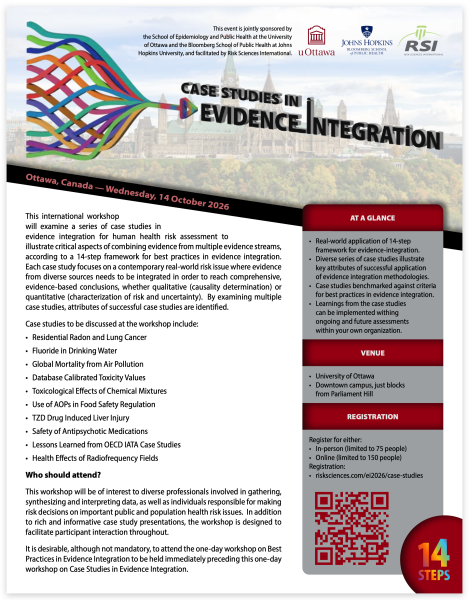
Case Studies in Evidence Integration Flyer
Feel free to download and distribute to interested parties.

This event is jointly sponsored by the School of Epidemiology and Public Health at the University of Ottawa and the Bloomberg School of Public Health at Johns Hopkins University, and facilitated by Risk Sciences International.