A Risk Sciences International Case Study

Wildfire and residential smoke risk communication

RSI studies health risks of smoke

Client: Environment and Climate Change Canada, Health Canada

Listing of the client in no way affirms the client's support, sponsorship, or validation in any form of Risk Sciences International or the RSI staff member(s) who conducted this project during their stay with RSI or prior to joining the company. This case study is displayed for informative purposes only to demonstrate the capacity of RSI staff members. This case study reveals no proprietary information or information deemed sensitive.

Project description:

Wildfire and residential smoke risk communication

Government authorities faced recurring challenges in communicating health risks from smoke caused by both wildfires and residential burning. While these events were becoming more frequent and more severe, the public health messages often failed to resonate with affected communities or to change behavior. RSI was asked to examine the effectiveness of current communication approaches and to provide recommendations for clearer, more targeted messaging.

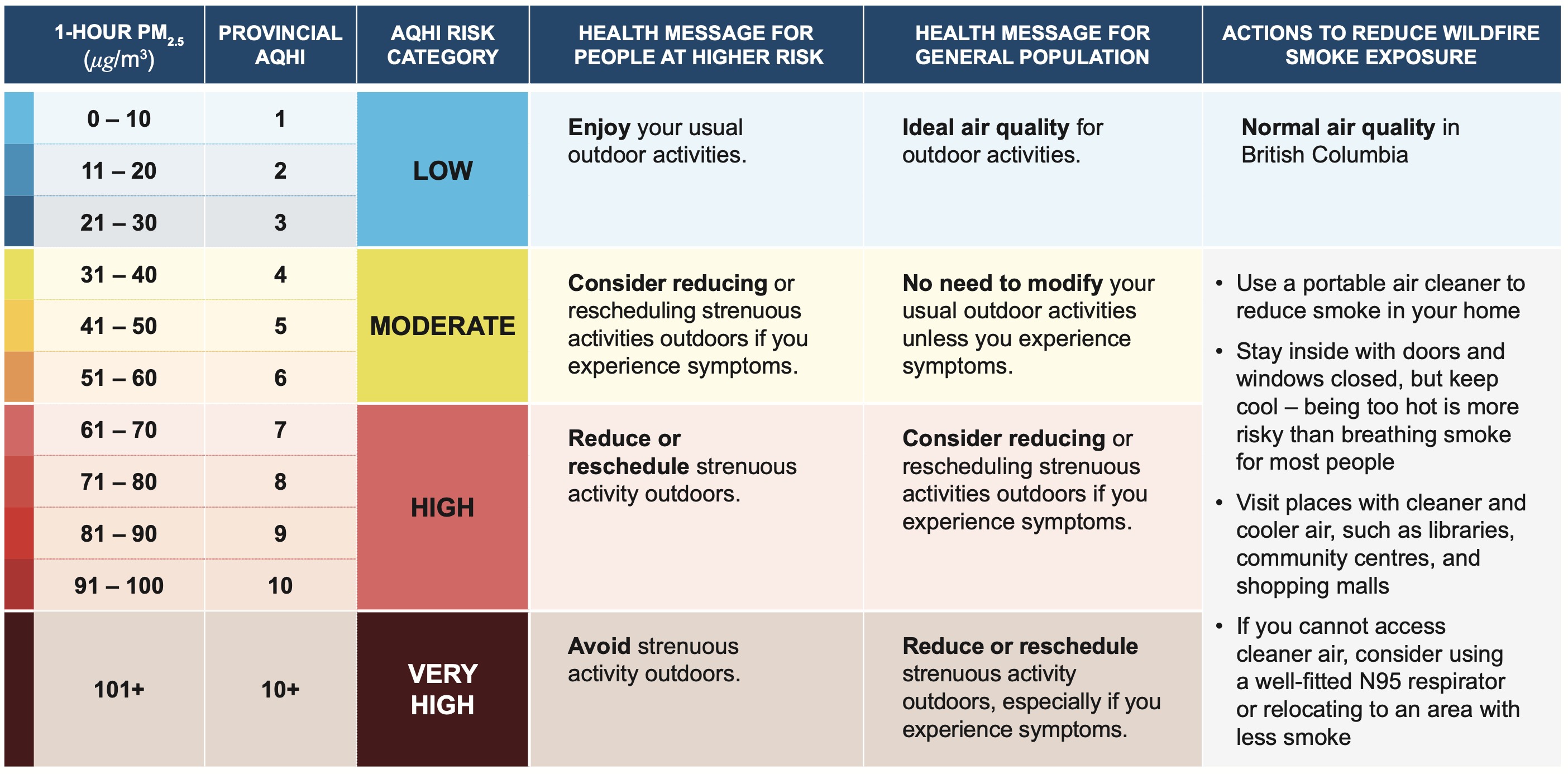
The project began with a literature and media review, along with interviews of government officials and air quality advocates involved in smoke response. Analysis focused on both the risk perceptions of affected communities and the content of the messages being issued. The effectiveness of the messaging was evaluated in terms of clarity, credibility, and usefulness in guiding protective behavior. RSI also examined innovative tools such as the AQHI-Plus developed by the British Columbia Centres for Disease Control, which adapts the Air Quality Health Index to reflect smoke-specific particulate exposures.

The outcome was a report synthesizing findings and setting out recommendations for improved smoke-related health risk messages. RSI then applied risk communication principles to the development of revised AQHI messages tailored for wildfire smoke and residential smoke separately. These messages were structured to improve comprehension, support informed choices, and increase protective action, thereby strengthening public health preparedness in the face of escalating smoke events.
Experts related to this case study

Anne Wiles

Senior Analyst

Dr. Anne Wiles joined Risk Sciences International (RSI) in 2008, where she currently serves as a Senior Analyst specializing in risk communication, perception, and governance. With a distinctive blend of expertise in language, regulation, and the use of science in...
Read More about Anne Wiles

More RSI Case Studies

RSI presents a very small selection of case studies to highlight some of its key work.

Risk-based decision making framework

The Alliance of Blood Operators (ABO) sought to move its members toward a consistent, transparent approach to risk-based decision-making. Having worked through the development of a framework, the organization now wanted formal adoption, external validation, and practical application to real-world...
Read More about Risk-based decision making framework

Marine Planning and Conservation National Ecological Risk Guidance: Risk Communication Expertise

To support the refinement and implementation of its ecological risk guidance, a federal department responsible for marine conservation engaged expert assistance in risk communication. The primary objective was to ensure that the national guidance for ecological risk assessment—developed as part...
Read More about Marine Planning and Conservation National Ecological Risk Guidance: Risk Communication Expertise

Food safety risk analysis tools

The World Health Organization and the Food and Agriculture Organization of the United Nations asked RSI to develop a suite of online tools to support food regulators and the food industry in applying risk-based approaches to food safety. These organizations...
Read More about Food safety risk analysis tools

Expansion of the Stochastic Health Canada Quantitative Microbial Risk Assessment Tool

Health Canada sought to enhance its Quantitative Microbial Risk Assessment (QMRA) tool, originally developed over 15 years ago for stakeholders responsible for drinking water systems. With advancements in probabilistic modeling and microbial risk assessment, the client required updates to reflect...
Read More about Expansion of the Stochastic Health Canada Quantitative Microbial Risk Assessment Tool

Development of a National Food Safety Information System and Risk Assessment Capacity in Vietnam

Authorities in Vietnam sought targeted expertise to strengthen the country’s ability to detect, assess, and respond to food safety threats. This initiative had two linked objectives: building a comprehensive, transparent, and reliable national food safety information system, and enhancing risk...
Read More about Development of a National Food Safety Information System and Risk Assessment Capacity in Vietnam

External Peer Consultation of the Inorganic – Late Biomonitoring Approach Draft Screening Assessment Report

To support the Chemicals Management Plan under the Canadian Environmental Protection Act (CEPA), Health Canada sought expert peer consultation for a draft screening assessment report (DSAR) evaluating 47 inorganic substances identified as priorities. The client required independent scientific and technical...
Read More about External Peer Consultation of the Inorganic – Late Biomonitoring Approach Draft Screening Assessment Report

Evaluation of Toxicological Data on Experior

To support the evaluation of a new veterinary pharmaceutical product intended for use in bovines, a scientific review was requested of submitted toxicological data related to the active compound LY488756. This compound, proposed under the product name Experior, had been...
Read More about Evaluation of Toxicological Data on Experior

International newspaper rethink

The International Herald Tribune (IHT) sought guidance at a time of profound change in the media landscape. With the World Wide Web emerging and competition intensifying from global and regional editions of established outlets such as The Economist, The Wall...
Read More about International newspaper rethink

Characterizing uncertainty in MAF values estimated using the KEMI MAF

The client sought to improve understanding of uncertainties surrounding the application of mixture assessment factors (MAFs) for aquatic receptors, specifically those estimated using the KEMI methodology. While the KEMI MAF approach is considered technically robust, its assumptions—particularly about chemical-specific controls,...
Read More about Characterizing uncertainty in MAF values estimated using the KEMI MAF

Finalization of Risk Assessment on Secure Opioid Dispensing Devices

To support decision-making around modifications to opioid agonist treatment delivery, a detailed risk assessment was requested to evaluate the integration of secure dispensing devices for direct patient access to hydromorphone. Building on a previously conducted preliminary assessment, the work required...
Read More about Finalization of Risk Assessment on Secure Opioid Dispensing Devices

Risk Model Framework for Foodborne Campylobacteriosis via Poultry Meat Pathway

To support national public health goals, RSI was tasked with developing a quantitative microbiological risk assessment (QMRA) model to estimate the human health risks associated with the consumption of chicken in New Zealand. The core objective was to quantify the...
Read More about Risk Model Framework for Foodborne Campylobacteriosis via Poultry Meat Pathway

Food Inspection Scientific Analysis & Risk Modelling

In support of ongoing efforts to modernize Canada's food inspection system, a request was issued for scientific and analytical expertise to enhance two critical risk-based decision tools: the Establishment-based Risk Assessment (ERA) and Importer Risk Assessment (IRA) models. These models...
Read More about Food Inspection Scientific Analysis & Risk Modelling

Technical Support for Risk-Based Decision Making (RBDM)

To enhance the oversight of cannabis production under its regulatory mandate, the Cannabis Directorate sought expert support in developing a risk-based decision-making framework tailored to its compliance and enforcement responsibilities. The directorate aimed to better assess and respond to non-conformance...
Read More about Technical Support for Risk-Based Decision Making (RBDM)

Risk-Based Optimization of Enforcement Activities

A federal agency required scientific support to enhance the effectiveness of its environmental enforcement activities. This involved identifying and analyzing the risk factors—both environmental and human health-related—that contribute to the likelihood and impact of regulatory offences. The objective was to...
Read More about Risk-Based Optimization of Enforcement Activities

Communication material on lithium in drinking water and health risks

To support public communication around emerging drinking water concerns, RSI was engaged to develop accessible, scientifically grounded materials on lithium exposure and its potential health effects. The work focused on equipping stakeholders with clear, credible information that could inform both...
Read More about Communication material on lithium in drinking water and health risks

Applying New Assessment Methods (NAMs) for Assessing Semi-Volatile Organic Compounds (SVOCs) in Indoor Residential Environments

Health Canada sought expert support in advancing its efforts to develop screening values for semi-volatile organic compounds (SVOCs) commonly found in residential indoor environments. Previous work on indoor air contaminants had focused on volatile organic compounds (VOCs), where screening values...
Read More about Applying New Assessment Methods (NAMs) for Assessing Semi-Volatile Organic Compounds (SVOCs) in Indoor Residential Environments

External Peer Review of the Draft Screening Assessment Report on Selected C3-C5 Alcohols

To support the quality and defensibility of regulatory decision-making under the Canadian Environmental Protection Act, 1999 (CEPA), Health Canada engaged Risk Sciences International to coordinate an independent external peer review of the Draft Screening Assessment Report (DSAR) for Selected C3-C5...
Read More about External Peer Review of the Draft Screening Assessment Report on Selected C3-C5 Alcohols